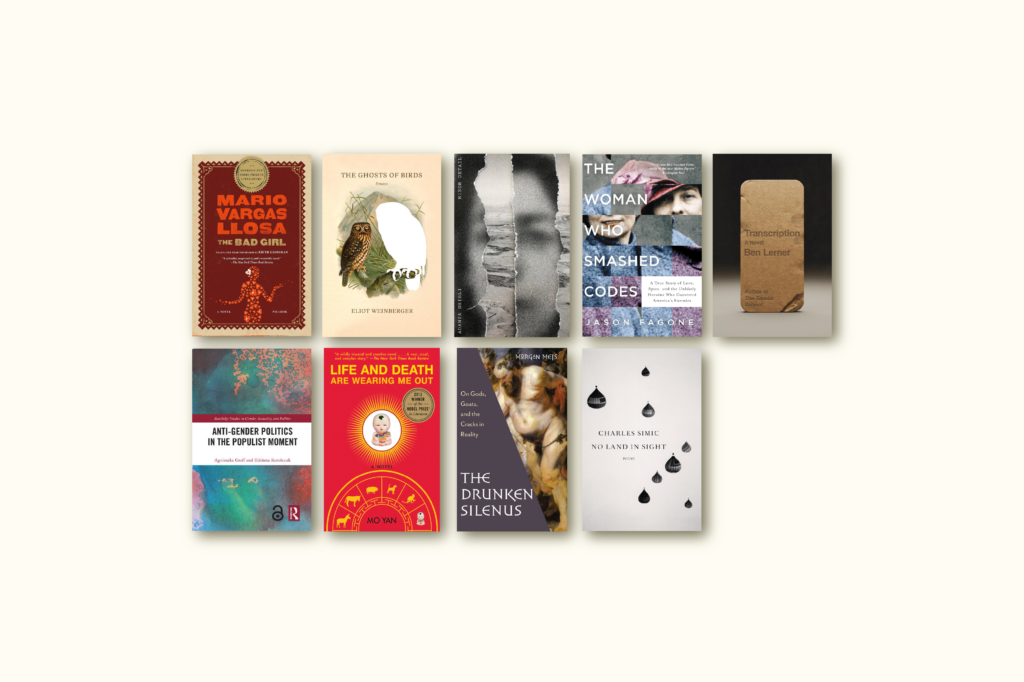

This was an odd little month for me. Terribly unfamiliar. Administratively, I was – for the first time in 12 years – not working. At all. My own little slice of sabbatical – I think I can call it that. And this period of deep unclenching of the jaw brought forth something unexpected in my book selection. Quite accidentally, I ended up reading as much nonfiction as fiction. Which, for me, is suspicious behavior. I mean, borderline character development. I didn’t plan it, didn’t set an intention, didn’t wake up one morning thinking yes, today I become a person who seeks truth in facts rather than projection in novels. God no, nothing that clean. It simply happened, just like my sudden decision to up and quit my job and rest for a whole month. Questionable, if you look at the state of the world. However, this sudden pull towards hard facts, not fiction, didn’t feel like a deviation at all. It sounds strange coming from me, yes, but my best guess is that I needed to ground myself somehow. Maybe borrow a solid brain for a weekend. Maybe read about something that actually happened, not lose myself exclusively in lands borrowed from the imagination.
My kryptonite has always been the sheer delusion that one of these days, one of these books will miraculously save me and get me out of all my predicaments. Unreasonable expectation to place on literature, I know, but here we are. If I’m being honest, though, I don’t even think I want to be saved anymore. What I mean is that I don’t want to pretend anymore that that’s possible. I’ve read enough to know better. What I want – what I kept searching for this month, whether consciously or not – is something smaller. Finally accepting that books don’t save, they just make it slightly harder to lie to yourself. Which, depending on the day, might be the same thing.

The Bad Girl, Mario Vargas Llosa, translated by Edith Grossman, Picador, 2008
Is there anything more jarring and frustrating than being disappointed by a writer you already respect? Maybe a handsome fruit that looks delicious, but alas, isn’t. When I picked it up, I figured, it’s Mario Vargas Llosa, so it’s a good book. And on paper, it has all the right ingredients: obsession, exile, politics, a man narrating his life through the gravitational pull of a woman who refuses to be contained by it. A clear nod to Madame Bovary, that same restless, destructive desire dressed up as romance. And Llosa, for all his faults, knows how to build a world. The Parisian expat life is rendered with that clinical precision he does so well; the political undercurrents in Peru flicker in and out in a way that grounds everything, even when the emotional core starts to wobble.
But my problem was with her, the “bad girl”. I never bought into her. And that feels like the central failure of the book. Because she is supposed to destabilise everything, to exist somewhere between fantasy and autonomy, between cruelty and survival. Instead, she felt flattened and one-sided; she was reduced to a projection, a mere vessel for male desire, male confusion, male endurance disguised as love. Sure, there are moments where her portrayal is more complex – you wonder if she isn’t “bad” at all but simply someone navigating the only forms of agency available to her, a survivor rather than a villain – but those moments never accumulate.
And then there are the parts that are harder to swallow. The bit where she comes back from Japan, brutally raped and tortured, and he keeps saying he loves her and can’t wait for her to be pretty again? Downright misogynistic. I know, I know, different times, male writers wrote their fantasies differently. But understanding the context doesn’t make the page hit any softer. Sometimes it just makes you more aware of what you’re reading.
It’s not a bad book. That would be too easy. For one, it nudged me back toward Chekhov, which I’m choosing to interpret as a win (more on that next month – the Chekhov is a brick, I’m not done). But it’s not a great book either. And he knows how to write those. I’ve checked.
If you’ve never read any Llosa, maybe don’t start with this one?

The Ghost of Birds, Eliot Weinberger, New Directions, 2016
Rarely have I been humbled in two seconds flat, but this man with his rare breed of brain did it. To my shame, this is the first book of his I’ve ever picked up, and I’ll forever be grateful to the article in the New York Review of Books that pointed me in his direction.
When I say Weinberger has a big brain, I mean that in the truest sense of the word. The depth of his knowledge is so vast, his erudition so immense, I feel stupid just entertaining the idea of “reviewing” this collection of essays, poems, prose, and random texts. So I won’t. I’ll just point at it and stammer.
He writes like someone for whom knowledge is not a discipline but a natural state of being. The range alone is dizzying: myth, religion, history, language, obscure textual variations across centuries, all of it moving seamlessly, never tipping into showmanship. There’s no sense that he’s trying to impress you. He just knows things. Structurally. In a way that makes you realise how thin most of our engagement with the world actually is.
The first essay, on the variations of the Adam and Eve story across Armenian, Georgian, and Latin traditions, takes something we think we know, something so culturally sedimented it feels almost fixed, and opens it up into multiplicity. I also lost my mind a bit reading The Imposter Named Buddha, about how Buddha had seamlessly metamorphosed into a Christian saint by the medieval period. Who knew. (Weinberger knew. Weinberger knows everything.)
This book was my whale carcass. It engulfed me in its scholarly magic. I moved through it as you move through something too large to fully grasp – circling, pausing, rereading, occasionally just sitting there going: how does one person hold this much? I mean, the scale is just insane. I came out slightly disoriented, very impressed, and with the uncomfortable but necessary awareness that I should probably be reading more like this if I want to recalibrate my sense of what thinking can look like.

Minor Detail, Adania Shibli, translated by Elisabeth Jaquette, New Directions, 2020
I have never been casual about anything in my entire life, least of all books that I love, and let me tell you: I LOVED this book. It destroyed me. It crawled inside my ribcage like flesh-eating bacteria, and I say all of this with the utmost love and respect for what Shibli has done with this tale of Palestinian erasure.
It’s based on a real incident from the summer of 1949: the rape and murder of a young Palestinian woman by Israeli soldiers, investigated 40+ years later using newly unclassified documents. The first part follows the soldiers in the desert during that summer, and the second part shifts decades later, to a woman who becomes obsessed with the incident after discovering a “minor detail” that connects her present to that past.
Where this book shines is in the author’s deliberate and obstinate refusal to centre what we’ve been trained to look for: aestheticised violence, dramatised plot, emotional climax. Instead, she directs your attention – with sparse, controlled language – to what would normally be considered peripheral: the arrangement of objects, the repetition of gestures, the small, almost absurdly trivial details that begin to take on weight precisely because everything else is being withheld. The soldiers carry out orders, eliminating what they perceive as threats. The violence, when it comes, unfolds with the same flat, careful attention as everything around it. A task is a task. A movement is a movement. A body is a body. A rape is a rape. A murder is a murder.
In a context where entire histories are erased, contested, or minimised, attention itself becomes a form of resistance, so what Shibli does here – recording, observing, insisting on the existence of detail, stripping everything of anything resembling narrative spectacle – is so subversive, so political.
It’s a small book, just over a hundred pages, but so so mighty. I beg of you to read it if you haven’t.

The Woman Who Smashed Codes: A True Story of Love, Spies and the Unlikely Heroine Who Outwitted America’s Enemies, Jason Fagone, Dey Street Books, 2018
God, give me a good book on a fascinating woman that history footnoted out, and I become unbearable about it for weeks.
Anyone interested in the history of cryptography knows William F. Friedman, the man who broke Purple, the Japanese cipher machine, but who knew that his wife was his cryptographic equal? She created a Coast Guard cryptographic team. She broke an Enigma without any help from Bletchley Park. She helped expose prohibition-era gangs and Nazi spy networks in South America during WWII. She is as much part of cryptographic history as he is, and yet here we all are, just learning her name.
The fact that one of the greatest cryptanalysts of the 20th century was a former Quaker schoolteacher and Shakespeare scholar is, frankly, marvellous. It disrupts the neat narrative we like to tell about expertise, about who gets to be “naturally” brilliant. Just like any woman who managed to do something of note throughout history, she didn’t enter this field through the front door; she walked in sideways – possibly through a bolted window or something – and then, against all possible odds and setbacks, proceeded to do what she did best.
What I loved is that the book doesn’t try to right history, doesn’t come with apologetic tones when describing this powerhouse of a woman and her many accomplishments that we’re just now hearing about, thanks to some records being unsealed decades after her death. It actually reads like a thriller: you hold your breath during the WWII code-breaking sections; you follow her from early experiments to crime networks to nazi spy rings, and at no point does it feel like you’re being walked through a timeline. It feels like you’re watching someone think in real time; you’re right there with her in the war room.
It makes me a little angry how easily we accept the version of history that’s handed to us, how rarely we ask whose names we remember and whose we don’t. I’m glad this book exists. I’m glad it places her back where she always belonged.

Transcription, Ben Lerner, Farrar, Straus and Giroux, 2026
This book came out on the 7th of April. I grabbed it and finished it the same day. (it’s short. don’t rush to congratulate me.) I will read everything Lerner writes and read it immediately.
This time, he’s toying with technology, memory, father figures, and eating disorders in children. Yeah, it’s a lot. But trust me, it makes sense together. Or he makes it make sense. He’s a master of making complex stories feel subtle, thoughtful, and layered in their non-linearity. Katie Kitamura comes close to this. Rachel Cusk maybe even closer. But Ben takes the crown.
All his books have an insane quality to them: it’s like they’re absorbing you into a particular frequency of thought that refuses to behave rationally. I feel like no other writer is generous enough to trust me to sit inside ambiguous narratives without panicking. He does. He knows that meaning can accumulate slowly, in fragments, in echoes between sentences rather than in the sentences themselves.
Every time I finish one of his books, I have the same thought: how is he this good, and also this different, every single time? Huge deal when you think about it.

Anti-Gender Politics in the Populist Moment, Agnieszka Graff, Routledge, 2022
Prompted by übermensch Weinberger and Elizabeth Friendman, I continued my accidental wandering into nonfiction territory with this small but mighty political text.
I tend to approach academic texts with a kind of cautious respect, like they might either school me or humiliate me – I’m ok with both, by the way. This one actually did neither. It just engaged me. Graff writes about the rise of anti-gender movements, particularly in Poland, in a very legible way. I’m not saying she’s actively simplifying jargon for the layman, I’m saying she’s very good at mapping everything clearly, at making abstract concepts come alive. She trusts the material, and she lets the arguments build without constantly reminding you that they’re arguments, which makes the reading less about decoding language and more about thinking through implications. She makes it very easy to start to see the patterns: how “gender ideology” becomes a catch-all threat, how political actors mobilise fear around it, how it folds into broader right-wing narratives about nation, tradition, identity.
I did feel some threads could have been pushed further; some edges were maybe left unexplored for my taste. But maybe that’s inevitable with a topic still actively unfolding, still mutating in real time. A decent read for anyone trying to grasp how the right-wing rise started, what it feeds on, and how it’s going.

Life and Death Are Wearing Me Out, Mo Yan, translated by Howard Goldblatt, Arcade, 2012
I feel like I need to start by saying that I totally get why this guy won the Nobel, though I still remember when I heard the news, and I guffawed, not having read anything written by him. Oh well. I was young. What the hell did I know? Fast forward 14 years, and here I am, deeply grateful for this twisted tale of guts and glory. And pig gonads.
Also, a fun fact I can’t stop thinking about: he wrote this 550-page epic in 43 days with an ink calligraphy brush. He doesn’t like writing on the computer. Obviously.
I’m not going to go into too much detail about the plot; I’m just going to say that Mo Yan basically takes what could have been a straightforward historical novel about Mao’s land reforms and turns it into something sprawling, grotesque, funny, and unexpectedly tender. How does he manage that? By killing his protagonist on page one and then reincarnating him again and again. As a donkey, an ox, a pig, a dog, and a monkey. One life after another, all tethered to the same village, the same shifting political landscape, the same slow rise of a more violent and totalitarian China.
It has all the right ingredients: an excellent sense of humour, gruesome violence, and clever social commentary. I do wonder how he got away with publishing this violent depiction of the crude politics of provincial communism. How it ever saw the light of day. The satire definitely helped make everything more palatable. One moment you’re laughing at something almost slapstick in its cruelty, the next it snaps into something so brutal the humour collapses. The book never settles into one register for long; it keeps moving and mutating. It’s quite beautiful to experience as a reader.
If you want to teach young people about the horrors of communism, maybe make them read stuff like this for a change.

The Drunken Silenus, Morgan Meis, Slant Books, 2020
Why did I read a book about old, very fat and very drunk Silenus – tutor of Dionysus and leader of the satyrs – who once famously answered king Midas’s question “what is the best thing in the world for men?” with the cheerfully nihilistic “the best thing in the world for men is to never have been born”?
Your guess is as good as mine.
I don’t even remember how I stumbled on it, from what corner of the internet I unearthed the fact that this book actually exists. But this is not important. What’s important is that, for a book on art criticism (renowned for their high brow verbiage), this one is actually refreshingly funny: it moves from Renaissance deconstruction to deeply unserious anecdotes without losing coherence. And it isn’t only about Silenus per se – it’s about Rubens (and Rubens’s cheating dad), and about Nietzsche, who was heavily influenced by Silenus’s garrulous quote when he wrote The Birth of Tragedy. According to Nietzsche, Silenus was the greatest hero because he embraced the violent, irrational forces at our core. And indeed, that’s the way he’s long been viewed – even in Rubens’s sympathetic depiction, even in Titian’s Bacchus and Ariadne (where he’s a secondary character).
I may not know why I picked this book up, but I’m very glad I did. Let me tell you, there aren’t a lot of books out there that wrestle with chunky philosophical questions in a funny, non-academic way, that manage to stay playful, slightly irreverent, aware of their own eccentricity.
The only fault I saw: at times, it does get a tad repetitive. If I have to read one more sentence about the letter Rubens’s mum sent to his dad post his fornication with Anna of Saxony, I will tear my hair out thread by thread. But other than that, bomb read. Loved it. Read it slightly tipsy – which, given the subject matter, I consider to be entirely appropriate.

No Land in Sight, Charles Simic, Knopf, 2022
Succinct and devastating, just how I like my poetry to be.
I’ve been coming back to Simic on and off throughout my life, and this had been on my shelf for a while, but because it’s his last collection (he died in 2023, a year after publishing this), I kept postponing reading it. Knowing these would be the last poems I’d read from this giant talent of a man, I didn’t have the heart to pick them up. I just couldn’t bear the fact that it was the last time his voice arranged the world for me in such a beautiful way.
What can I tell you about these poems? They have a darkly tender quality; they’re almost noir in vibes. His humour touches both the absurd and the gallows, sending a chill through you while somehow uplifting you at the same time. He had this gift for making the ordinary feel existential: streets, trees, late-night thoughts.
In this last book, he writes with such economy about both the sheer stupidity of the world and its utter beauty. Tiny four-line poems with the brevity of a great haiku and the depth of a whole life.
He truly was one of the good ones. What a monstrous and wondrous body of work. What a sweet way to say goodbye.
THE WIND HAS DIED
My little boat,
Take care.
There is no
Land in sight.
Final Word
Pay attention to what you feed your mind. Read what humbles you, ego bruising be damned. Read books that make you angry, that squirm in your hands, that crawl in.
And take care of the little boat. I’ll try to do the same.
See you in May.